
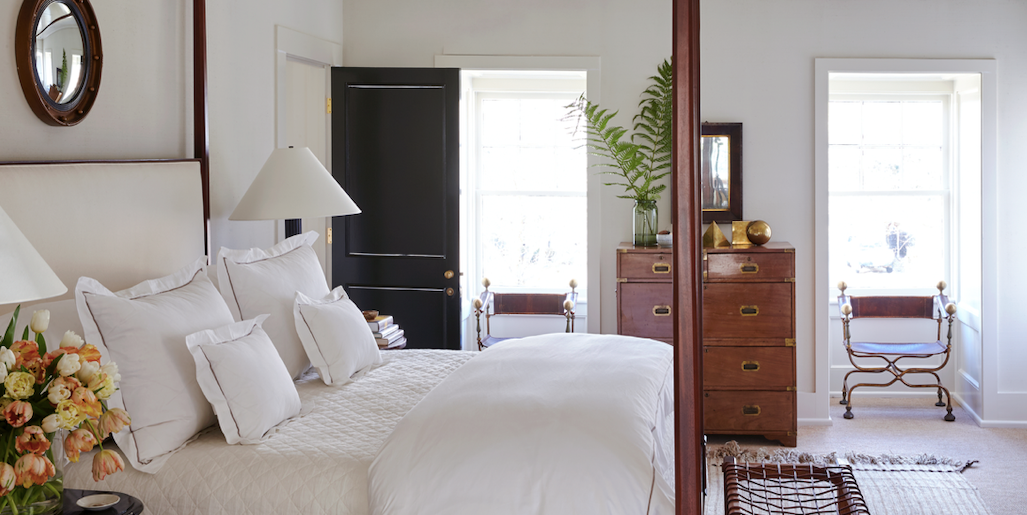
Style and Shape
When choosing a nightstand, you should consider both the style and the shape. The former informs how it looks in your bedroom and integrates into the rest of your decor while the latter informs its functionality.
“I like nightstands that are a similar height to the bed and deep enough to hold a few items,” says Kraiem. “They can be any shape, such as rectangular, round, or oval.”
Nightstands typically offer open storage, or shelves, closed storage, like drawers, or a combination of both. Consider which items you’ll want to store in your nightstand and choose an option that offers the right type and amount of storage space.
Color
Once you start searching for nightstands you’ll find that they come in a wide range of colors, though most tend to fall in neutral territory (think: black, wood, or white). That said, you’ll also find plenty of bold colors and patterns, like natural marble or lacquer finishes.
While there’s no one-size-fits-all approach to choosing the color of your nightstand, Marshall’s one rule of thumb is that it should be a contrast from the bed. If you have a light colored bed frame, opt for a darker nightstand. Ultimately, it really just comes down to a matter of personal preference. “I like stained wood or pieces with a patina for added character,” says Kraiem.
Size
Nightstands come in a wide range of sizes, and the ideal size depends on the size of the room as well as the bed. “Length depends on the space, but the average depth is around 17 to 20” inches, and the height is usually 27 to 28 inches,” explains Kraiem. “I like to place nightstands about 5 inches away from the bed, so any nightstand that fits within that space and doesn’t feel too small tends to work well.”
Remember that a piece does not have to be called a nightstand to function as a nightstand. “If it’s the right height and scale for the room, almost any table can be a nightstand,” says Marshall. “I love a desk as a nightstand, as well as a skirted table. We also frequently use smaller side tables as nightstands in guest rooms where drawer storage usually isn’t a priority.”
Price
Just like any other piece of furniture, nightstands span a wide price range, from budget-friendly picks that are only a few hundred dollars up to several thousand dollars for a single nightstand. It’s important to establish your budget before you start shopping and sift through all of your options accordingly.
While you don’t need to spend thousands of dollars to bring home a good quality nightstand, you get what you pay for when it comes to materials and construction. “$1,000–$1,500 is a reasonable price range for a high-quality nightstand,” says Kraiem.
Material
Most nightstands are made from wood, metal, engineered wood, wood veneer, marble, or rattan, and oftentimes a combination of these materials. “The materials used for the frame and drawers make a difference in durability and functionality,” says Kraiem. “Wood is often preferred for its strength and classic look, but metal or lacquered finishes can also be great depending on the aesthetic.”
Kraiem typically prefers wood over other materials, at least when it comes to nightstands with drawers, because the drawers in wooden nightstands are generally the easiest to open.
Just like contrast is key when it comes to color, the rule applies to texture, too. “I love a skirted nightstand next to a wood-framed bed, a lacquer nightstand next to an upholstered canopy,” says Marshall.
link