

The worst floor plan Farheen Charanya has ever seen is a remodel she’s working on right now. “It’s terrible. It’s absolutely terrible,” says the principal at Dallas-based F+E Design Architects. “The kitchen was placed in the center of this floor plan. Right behind the stove is the corridor that leads to the garage. So could you imagine walking in the garage and then [you’re] right at the stove?”

Sometimes trendy features end up not being the best use of your square footage. Roberts came up with this plan to expand a bathroom by absorbing a bedroom niche.
Courtesy Michelle Kopfer Roberts/“after” image by Regan Elizabeth Photography
Michelle Kopfer Roberts, owner and principal designer at Michelle’s Interiors, has seen her share of problematic layouts as well. One client’s hallways left her befuddled. “The hallways [were] like lightning bolts! You don’t want angle, angle, angle. It was strange.” Then there was the client who opted for a trendy niche at the entrance to her bedroom — it ended up just being wasted square footage until Roberts came in and offered an alternative.
When it comes to floor plans and layouts, so much depends on who is living in the home and how they live in it, points out Charanya. Single people have different needs than couples, families or multigenerational households, so there’s really not a one-size-fits-all approach. Still, there are principles to follow — and quirks to avoid — if you want to maximize functionality and future resale value.
Floor plan and layout basics
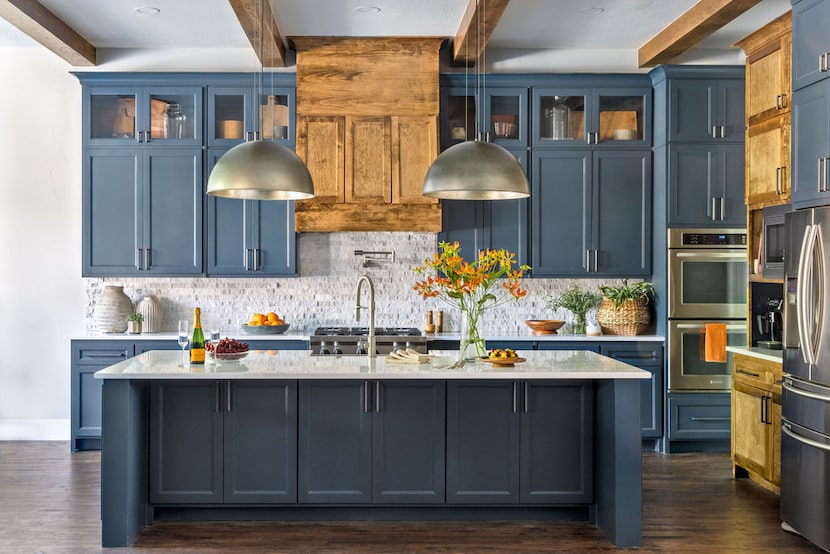
Make sure your cabinets, appliances and doors don’t block pathways or hit walls when opened, says Roberts, who designed this kitchen.
Regan Elizabeth Photography
In all cases, you need room to maneuver. Don’t trim so much space that, for example, appliances, cabinets and doors completely block the way or hit walls when you open them. If you’re thinking of buying a home, open and shut doors as you walk through so you can see if the layout works. Where rooms are necessarily small, consider creative storage opportunities.
Notice the windows. South- or west-facing windows will generate the most heat. Charanya is working with a family who bought a home that looked amazing on paper, but reality hit once they moved in. “They’d put these large windows on two walls [that] received the most sunlight. One was west facing and the other was south facing.” It was a gorgeous living room with a breathtaking view, but one that they couldn’t use in the afternoon and generated a huge AC bill. “I helped them with converting that space into something that could be more usable and had more intuitive zones for their family,” Farheen notes. (If you have a similar situation, you could reorient your seating away from the windows, install solar shades or zoned AC, or consider features that redirect or diffuse light — adding a light shelf or extending the depth of the surrounding wall with an insulated window seat.)

In this home designed by Farheen Charanya, the window between the kitchen and dining space both brings in natural light and offers a visual separation in an open room.
Becca Lea Photography
At the same time, you want to make sure your home brings in enough natural light. “You don’t want [a space] like a warehouse, and then all of a sudden the spaces are dimly lit and you are using a lot of artificial light,” Charanya notes. Sound is also a factor. How does it carry through the home? An upstairs bonus room for the kids is great, unless the noise isn’t contained and you need quiet elsewhere in the house — if you’re working remotely, for example. Consider bedroom placement, too, suggests Charanya. Say you have a multigenerational household; perhaps you want a split layout to give everyone more privacy. If you have small children, it might be better to have everyone in closer proximity.
If you’re looking at a home that already exists, Charanya recommends checking it out more than once, if possible, to get a sense of how the layout really works. “Maybe make two to three visits and space them out so you can really get a true feel for this large commitment that you’re about to make.” She’s even had clients take her to walk-throughs of prospective homes so she can give them a pro’s perspective.

A floor plan doesn’t need to be perfect if the home is otherwise what you need, says designer Michelle Kopfer Roberts. In this house, she expanded the primary closet by taking space from a hallway closet.
Regan Elizabeth Photography
But just because the floor plan is not perfect doesn’t mean a house is a lost cause, assuming the fixes are within your budget. “I absolutely think it’s reasonable to buy a home with the intention of changing the layout,” says Roberts. “Neighborhoods matter, areas of Dallas, areas of town matter, schools matter and affordability matters.” Charanya agrees: “Location is the make-or-break for a lot of people. The need to be close to your work, to your family, to your lifestyle … that dictates what you end up purchasing.” And of course, your layout needs may change as your lifestyle does. That could mean adding on to your home or changing up the existing space.
Related

Tailoring spaces for your needs
Fortunately, many floor plan issues can be fixed without a complete renovation, Roberts says. Sometimes you may not use each room as it was originally intended — for example, she has changed up the purpose of a formal dining room. “We turn the dining room into a little cocktail room — a grouping of four chairs, fun light fixture, and we’ll add a bar area to the side,” Roberts notes.

Here’s a closer look at the finished bathroom after Roberts closed in a niche in the bedroom.
Regan Elizabeth Photography
Then there was that client who regretted the bedrom niche and decided she’d rather have a more spacious bathroom. “We closed in the niche and took out [a] void, and the bathroom became gorgeous,” Roberts says. “It was just such a stunning transformation and felt so much bigger.”

Charanya added this nook within a living room for a client.
Becca Lea Photography
Adds Charanya, “One of the spaces that I created was a quiet reading nook within a living space,” a spot that makes the larger room more dimensional. “So [look for ways to build in] those very intentional moments where flexibility is there, but with a purpose.”
Sure, sometimes a full remodel could be needed, but keep in mind that “there are smaller moves that can be made,” continues Charanya. “Small, very strategic moves that can have a big impact overall. But the key is really studying your lifestyle and understanding where the needs are.”
Roberts agrees that understanding your needs is paramount. She offers the example of double islands, which are currently popular in large kitchens. Unless you have a real use for two islands, you may find out “you just have more obstacles that you’re walking around in your kitchen. One of my soapboxes is how quickly home design trends change. … With fashion, you can go buy some new jeans and you’re set. You can’t do that with a kitchen.”

Here, “having the sofa back up to the dining area shows clearly where one space begins and the other ends, and lighting centered over each rug helps delineate the space as well,” Roberts explains.
Regan Elizabeth Photography
Roberts likes “broken” open floor plans, where there’s a visual break, such as a half wall or a fireplace with passage on either side. There are non-architectural ways to break up an open room, too, as in the space Roberts designed above. She also likes open floor plans that make use of corners or are laid out in a T, so the whole space isn’t shaped like a shoebox.
Charanya raises concerns about true open floor plans as well. “They may look really appealing on paper, and even when you visited, it may feel like, ‘I’m walking into this huge space with high ceilings.’” But that’s precisely the kind of layout where noise and privacy become issues. She is often called in to put up walls or other forms of separation in a sprawling area. It’s about “creating spaces that actually can be used versus spaces that were just there to give that grand feeling.”
Above all, think about how a home’s floor plan and layout will meet your varied needs on a daily basis. You want “places where you can have moments of respite, moments of connection, moments of transition,” points out Charanya. “I think that it’s important to really, truly give thought to how, from the moment that you walk in the door until you have to leave again, the house is functioning for you.”
Love homes, gardens and design? Get more good stuff from Abode by following us on Instagram, Facebook and LinkedIn.
link